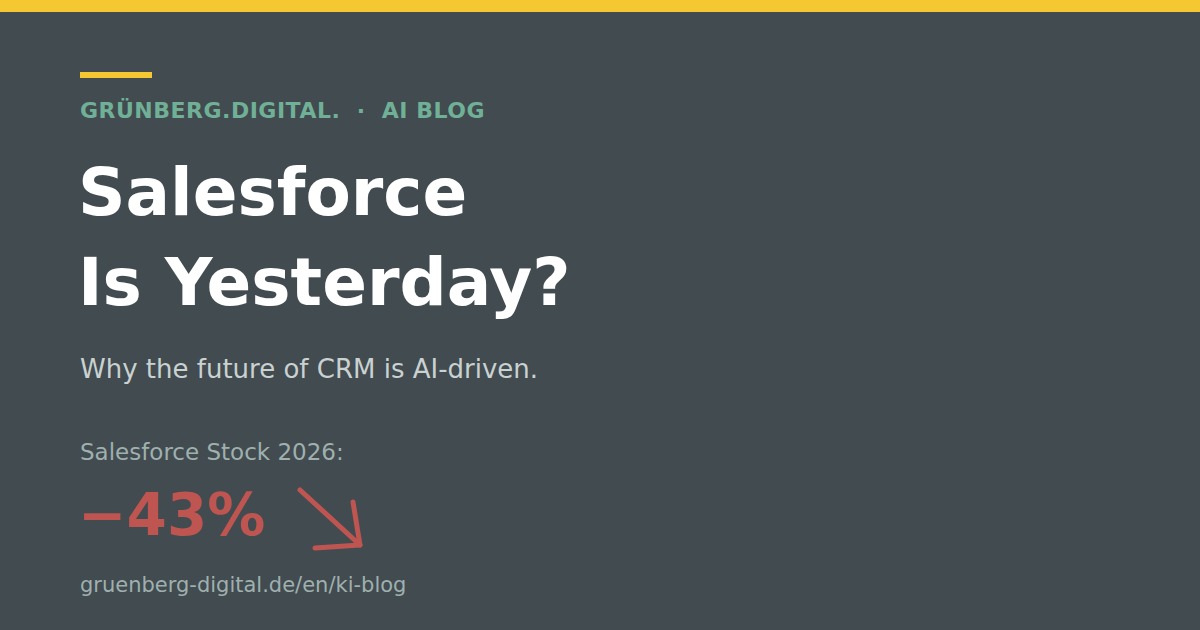
It is one of the most striking stock-market stories of the year: shares of Salesforce – for years a synonym for modern CRM – dropped around 43% in 2026, in a historic losing streak. "Salesforce is yesterday," the market whispers. But is that true? And what does the sell-off mean for anyone who uses or plans to adopt a CRM?
The short answer: the crash says less about Salesforce as a company and more about a strategic fear now gripping the entire software industry. This article puts the numbers in context, explains the term SaaSpocalypse, and shows what the shift from rigid databases to AI-driven systems means for small and mid-sized businesses.
In short: Salesforce stock is not falling because the business is collapsing, but because the market fears that AI agents will partly replace classic software. For SMBs the lesson is not "CRM is dead," but: make sure your customer data is AI-ready.
1. The crash: Salesforce stock in numbers
The facts are clear. Based on reports from early July 2026:
- Around −43% year to date – the stock fell to a level near 150 US dollars.
- A historic losing streak of more than a dozen consecutive trading days in the red.
- Around −28% since 1 June alone – the last positive close after the late-May quarterly results.
The 2026 trajectory looks like this (schematic, based on reported figures):
2. The SaaSpocalypse explained
The main reason for the sell-off has been given a catchy name: the SaaSpocalypse. It refers to the worry that autonomous AI agents could partly make classic software subscriptions (software as a service) obsolete – because the AI completes tasks directly instead of people laboriously clicking them together in input masks.
For heavily database- and interface-driven systems like classic CRMs, this is a real strategic question. On the market, Salesforce is therefore seen as one of the most affected names. Still: such shifts rarely happen overnight – the transition will likely take years.
3. The other side: solid fundamentals
For all the drama, it pays to look soberly at the business figures – which tell a different story:
On top of that, most analysts still rate the stock a Buy, with a 12-month price target well above the current level. The sell-off reflects worries about the future, not current earnings.
Note: this article is an analysis, not investment advice. Figures on prices and metrics are based on publicly reported values (as of early July 2026) and may change.
4. The real shift: from database to AI system
Behind the market noise is a genuine shift. The classic CRM was at heart a structured database with an interface: people enter data, maintain fields, pull reports. The AI era flips this logic.
- From passive to active: instead of merely storing data, AI-driven systems use it – summarising, prioritising, triggering processes.
- From mask to dialogue: instead of filling in fields, you describe a goal; the AI handles the steps in the background.
- From island to network: the value lies not in the single tool, but in open interfaces through which AI agents access the data.
It is no coincidence that every major vendor – Salesforce included – is equipping its systems with AI agents. Customer data stays valuable; what changes is how you work with it.
5. What it means for SMBs
For small and mid-sized businesses, the market nervousness is above all a strategic wake-up call – not a reason to panic or switch in a rush. Three practical takeaways:
- Data quality first. Whether AI agents can use your CRM well is decided by clean, complete customer data – not by the vendor's logo.
- Insist on openness. Choose systems with good interfaces (APIs) so AI tools can plug in. A closed system becomes a dead end in the AI era.
- Apply AI where it saves effort. Not every company needs autonomous agents right away. But tasks like data maintenance, summaries or follow-ups can already be automated sensibly today.
This is exactly where we come in at Grünberg.Digital.: we help set up customer data and processes so they hold up in the AI era – regardless of which system sits on the login screen.
6. Conclusion: not the end, but the rebuild
"Salesforce is yesterday" works as a headline but is too simple. The company keeps making money and growing; what suffers is the market's trust in the old software logic. For users, what matters is less the stock than the insight behind it: the CRM world is shifting from rigid databases to AI-driven systems. Whoever makes their customer data AI-ready today will be ahead tomorrow – no matter what the next headline says.
Our tip: take the market noise as a prompt for an honest CRM check: how well is your customer data maintained, how open is your system, where could AI save effort right away? Get in touch – we will look at what fits your business.