If you run a Google Ads account, you know the reproach from the account itself: “Your data strength could be improved.” Until now, this was a recommendation, but not a figure. Since 10 September 2026, that has changed. Google has announced a Data Strength Uplift Metric that shows in the account how many additional conversions your first-party data setup captures – i.e. the interplay of Enhanced Conversions, Data Manager connections and the Google tag gateway.
In the same step, Google built Data Manager into Google Analytics and Display & Video 360, switched the associated API to an industry standard and released its open-source experimentation tool Meridian GeoX worldwide. This article explains what of this counts for a mid-sized account – and where the new metric promises more than it can prove.
1. What Google announced on 10 September 2026
The announcement comes from a blog post by Nipoon Malhotra, who is responsible for Ads Analytics, Insights and Measurement at Google. Google sums up the new features in a triad: one data foundation, several measurement signals and causal proof. Specifically, there are five changes behind this.
First, Data Manager – previously a tool in the “Tools” area of Google Ads, where the website tag, CRM data, offline conversions and customer lists come together – is being integrated directly into Google Analytics and Display & Video 360. Second, the Data Manager API is becoming universal: it is now based on the IAB Tech Lab’s ECAPI standard (Event and Conversions API), an industry specification for exchanging conversion and audience data. Third, Enhanced Conversions are now also available in Analytics and DV360. Fourth, new diagnostics in Data Manager are intended to detect data problems before they affect campaigns. And fifth – the real hook – the Data Strength Uplift Metric appears in Google Ads.
In addition, there are three extensions to Meridian, Google’s open-source model for marketing mix modelling: agentic help for data checking and model building, brand signals such as branded search volume as a model variable, and the worldwide release of Meridian GeoX for regional causal experiments.
In short: Google is moving the burden of proof for the value of first-party data from the blog into the account. Instead of a general percentage in a presentation, there will in future be a figure next to your own campaigns – calculated by the same system that benefits from more data.
2. Data Strength Uplift Metric: what the figure measures – and what it does not
According to Google, the Data Strength Uplift Metric calculates the additional conversions captured by your first-party data setup. The word “captured” is crucial. The metric does not claim that your ads would have sold more. It claims that sales that took place anyway would not have reached the account without Enhanced Conversions, offline import and tag gateway – because the browser blocks the cookie, the user refuses consent or the deal was closed on the phone.
The idea of “data strength” is not new. For over a year, Google has been describing a sequence of stages: connect the tag, enrich signals, activate enriched data for Smart Bidding. What is new is that a figure is now attached to this sequence, which can be tracked over time and – that is the obvious intention – shown to management.
Important for context: the metric is a model, not a count. Google estimates how many conversions would have been lost without the setup. You cannot recalculate this estimate in the account, because you cannot observe the counterfactual – your account without Enhanced Conversions. If you want to know how big the gap really is, you need an independent comparison, for example between Google Ads conversions and the deals in your own CRM or shop system. What such a comparison looks like is described in our article on tracking analysis.
3. Data Manager in Analytics and DV360: one data pipeline instead of three
For most mid-sized accounts, the second part of the announcement is of more practical importance than the metric. Until now, Data Manager was tied to Google Ads; if you wanted to use offline conversions or customer lists in Analytics, you needed a second route. Now there is one data pipeline for three systems: whatever is connected once in Data Manager is available in Google Ads, Google Analytics and DV360.
Switching the API to the IAB Tech Lab’s ECAPI standard is a signal in the same direction. The standard describes how conversion events are exchanged between advertisers and platforms – not only at Google. If you build a connection today, for example from a CRM or an automation tool such as Make, you are working against a format that other platforms will also understand in future. The fact that Google already moved customer list uploads entirely to the Data Manager API on 1 April 2026 fits the picture: the old routes are being closed, the new one is getting wider.
The new diagnostics address a point we see constantly in account audits: conversion tracking was set up once and never checked since. The tag fires twice, the hashed email address arrives empty, the offline import has been failing for three weeks – and nobody notices because no warning appears. Whether Google’s diagnostics reliably detect these cases remains to be seen; that they exist at all is progress.
4. The figures Google cites – and where they come from
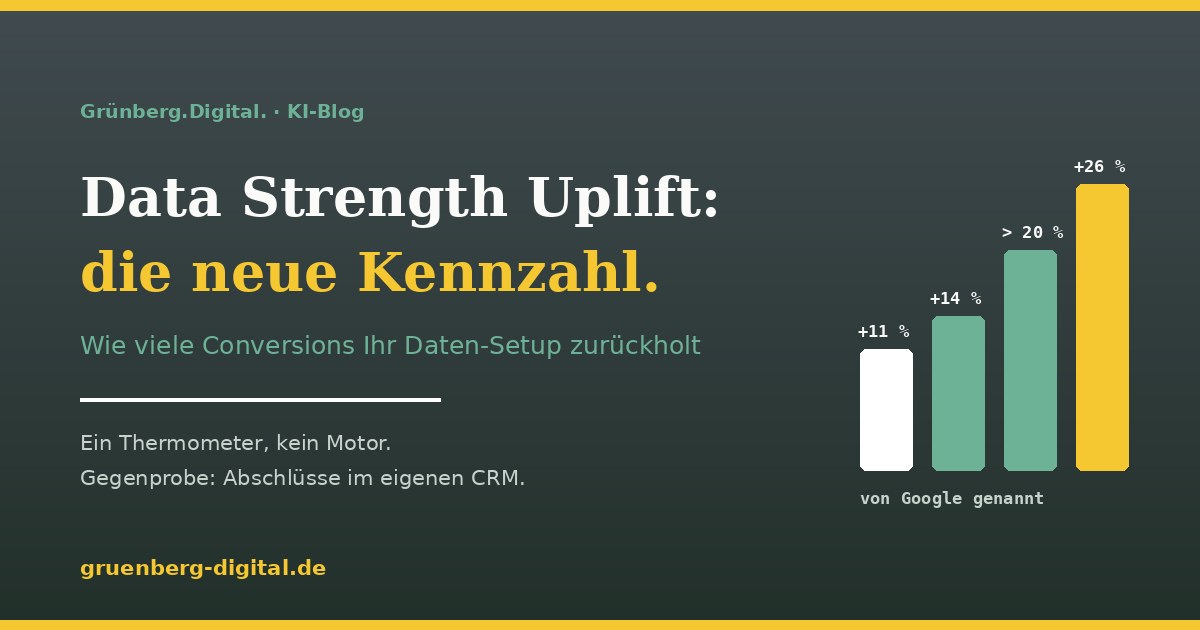
Google backs up the announcement with four percentages. They are worth looking at individually – not least because they all come from Google’s own data and none of them has been independently verified.
Bar length proportional to the percentage cited. The values measure different quantities (conversions vs. ROAS) and are not directly comparable.
The 11 per cent more Search conversions relate to Enhanced Conversions compared with a standard import. The 14 per cent for the Google tag gateway – which delivers measurement scripts via your own domain instead of a Google domain, so that the browser treats them as a first-party resource – has appeared in several Google communications since the beginning of 2026; according to a footnote in earlier publications, the value comes from the financial sector and a comparison of two half-years. The over 20 per cent applies to Demand Gen campaigns with tag gateway. And the 26 per cent more incremental ROAS was already heard at Google Marketing Live in May 2026; it relates to advertisers who have connected offline and app data with Data Manager.
What these figures have in common: they come from large accounts in which Google had enough data for a comparison. An account with 40 conversions a month will not be able to measure either 11 or 26 per cent cleanly – the fluctuation from week to week is greater than the claimed effect.
5. Meridian and GeoX: causality instead of attribution
The third block of the announcement concerns Meridian, Google’s marketing mix model that has been freely available since January 2025. Such a model estimates from aggregated spend and sales data which channel contributed how much to the result – without personal data, and therefore independently of cookies and consent. The catch: a mix model finds correlations. On its own, it cannot say whether a campaign caused sales or merely ran at the same time.
This is where Meridian GeoX comes in, generally available since 9 September 2026. GeoX holds individual regions out of a campaign and compares their development with regions that saw the campaign. This is a controlled experiment and therefore the strongest proof that marketing measurement can deliver. Google states that the results flow back into the mix model as calibration. What is also new is that brand signals such as branded search volume can serve as a model variable – an attempt to link video and TV campaigns with later sales.
For SMEs, the more exciting news is what has happened to price: in November 2025, Google lowered the minimum budget for incrementality experiments to 5,000 US dollars – from thresholds that had previously been as high as 100,000 dollars. And GeoX is open source. If you have the data and an analyst, you can use the tool without a licence. The question is rather whether a regional provider has enough comparable regions to experiment at all.
6. The flip side: self-measured uplifts and open questions
A metric that quantifies the value of sharing more data with Google, calculated by the system that benefits from this data sharing – that deserves sober consideration. You should bear three points in mind.
First: the uplifts are self-reported. None of the four figures has been independently verified. That does not make them wrong, but it makes them advertising claims rather than measured values. Second: the industry’s trust is not growing with the tools. The IAB’s “State of Data 2026” study found that up to 75 per cent of the buyers surveyed rate their current measurement methods as inadequate – after two years in which every new feature came with a positive percentage. Third: the models are also disputed. An analysis by a Zalando researcher published in August 2026 concluded that marketing mix models can overestimate the ROAS of paid search by a factor of 2.5, partly because experiment results are oversimplified when transferred into the model. It is precisely this transfer that GeoX is supposed to handle.
The conclusion from this is not “hands off”. It is: use the tools, but check their statements against figures that Google does not control – your incoming orders, your CRM deals, your till data. Why building your own data is the basis of any AI-supported campaign management anyway is something we described in the article on first-party data as a foundation.
7. What this means for small and medium-sized accounts
A mid-sized account with a monthly budget between 1,000 and 20,000 euros will feel the announcement in three places.
Smart Bidding only sees what arrives. Target CPA and target ROAS optimise for the conversions recorded in the account. If 15 per cent of deals are missing because the browser blocks or consent is missing, the algorithm learns from a distorted picture – and may throttle campaigns that are actually performing well. Enhanced Conversions and offline import are therefore not optional extras for corporations; they are the prerequisite for the automation to calculate correctly at all. The new metric makes this gap visible – even if its exact size remains an estimate.
Offline deals only count if they arrive in time. If you close leads on the phone or in the shop, you have to feed these deals back. This applies all the more since Google Ads has been ignoring late offline conversions in bid optimisation – details in our article on the 7-day rule for offline conversions. Data Manager, with its announced connection of store sales data from a CRM or a Google sheet, noticeably lowers the technical hurdle here.
The tag gateway is not server-side tracking. The tag still runs in the browser; only the delivery route switches to your own domain. If you already use the Cloudflare route, you get the effect almost for free. If you need real control over data sharing, you end up with server-side Tag Manager – when that pays off is explained in our article on server-side GTM.
8. Checklist: checking data strength in 60 minutes
You do not need a data scientist to check the state of your data foundation. An hour in the account is enough for the most important questions.
1. Enhanced Conversions active? Under “Goals” → “Conversions” → “Settings”, check whether the switch for Enhanced Conversions – combined since April 2026 – is on and whether hashed user data actually arrives in the diagnostics report. A switch that is on but receives no data is the most common mistake.
2. Consent Mode correct? Without a working Consent Mode v2, the signals Google needs to model users who decline are missing. How to check this is shown in our article on Consent Mode v2.
3. Offline conversions connected? If your deal happens outside the website: does it come back into the account – and within seven days? Data Manager shows under “Connections” when the last import ran.
4. Data Manager linked with GA4? The new integration does not do this by itself; the connection has to be made once. After that, customer lists and offline data are available in both systems.
5. Note the Data Strength Uplift Metric. As soon as the metric appears in your account, record the starting value. Not because it is precise – but because after every change to the setup you can see in which direction it moves.
6. Cross-check outside Google. Once a quarter, compare the conversions in the account with the deals in the CRM or shop system. The difference is your real data gap. It is the yardstick against which Google’s estimate has to be measured.
9. Conclusion: the figure is a thermometer, not an engine
The Data Strength Uplift Metric is a thermometer: it shows how warm it is in the account, but it does not heat. The value does not come from the metric, but from what it measures – a conversion setup that brings deals back into the account so that the bidding automation learns from reality rather than from a fragment.
The real shift is strategic. Google is moving measurement further and further into its own platform: one API, one Data Manager for three systems, a mix model with built-in experiments. That is convenient, and for many SMEs it is the only realistic option. But it also means that the entity spending your budget is increasingly also the entity measuring success. The counterbalance to this is not distrust, but a figure of your own to hold alongside.
Our assessment: if you have set up Enhanced Conversions, offline import and Consent Mode cleanly, you will see confirmation in the new metric. If you have not, you now get a figure that quantifies the gap – and thus an argument for closing it. Both are useful. Only interpreting the figure as additional revenue is something you should avoid.
Read also: Google Ads from 17 August 2026: what is changing for target CPA and target ROAS and Google Ads account analysis: the 7 most expensive mistakes.
10. FAQ: the most important questions about the Data Strength Uplift Metric
What is the Data Strength Uplift Metric in Google Ads?
A new metric announced by Google on 10 September 2026. It estimates how many additional conversions your first-party data setup – i.e. Enhanced Conversions, connections in Data Manager and the Google tag gateway – captures compared with an account without these connections. The figure appears directly in the Google Ads account and is intended to make the value of your own data foundation visible.
Is the uplift a real increase in sales?
No. The metric counts conversions that would not have been captured without the data setup – not sales that would not have happened without the setup. It measures measurement quality, not demand. It is nevertheless relevant for Smart Bidding, because the algorithm can only respond to signals it can actually see.
What has changed in Data Manager?
Data Manager, previously a tool within Google Ads, is now also built into Google Analytics and Display & Video 360. The Data Manager API has been switched to the IAB Tech Lab’s ECAPI standard, new diagnostics are intended to detect data errors before they affect campaigns, and Enhanced Conversions are now also available in Analytics and DV360.
Is Meridian GeoX worthwhile for small and medium-sized enterprises?
Meridian GeoX is Google’s open-source tool for regional causal experiments and has been generally available since September 2026. It requires enough regions with comparable demand and a budget that produces statistically measurable differences. For most SMEs, a clean conversion setup with Enhanced Conversions and offline import is the more sensible first step; GeoX becomes interesting from five-figure monthly budgets.