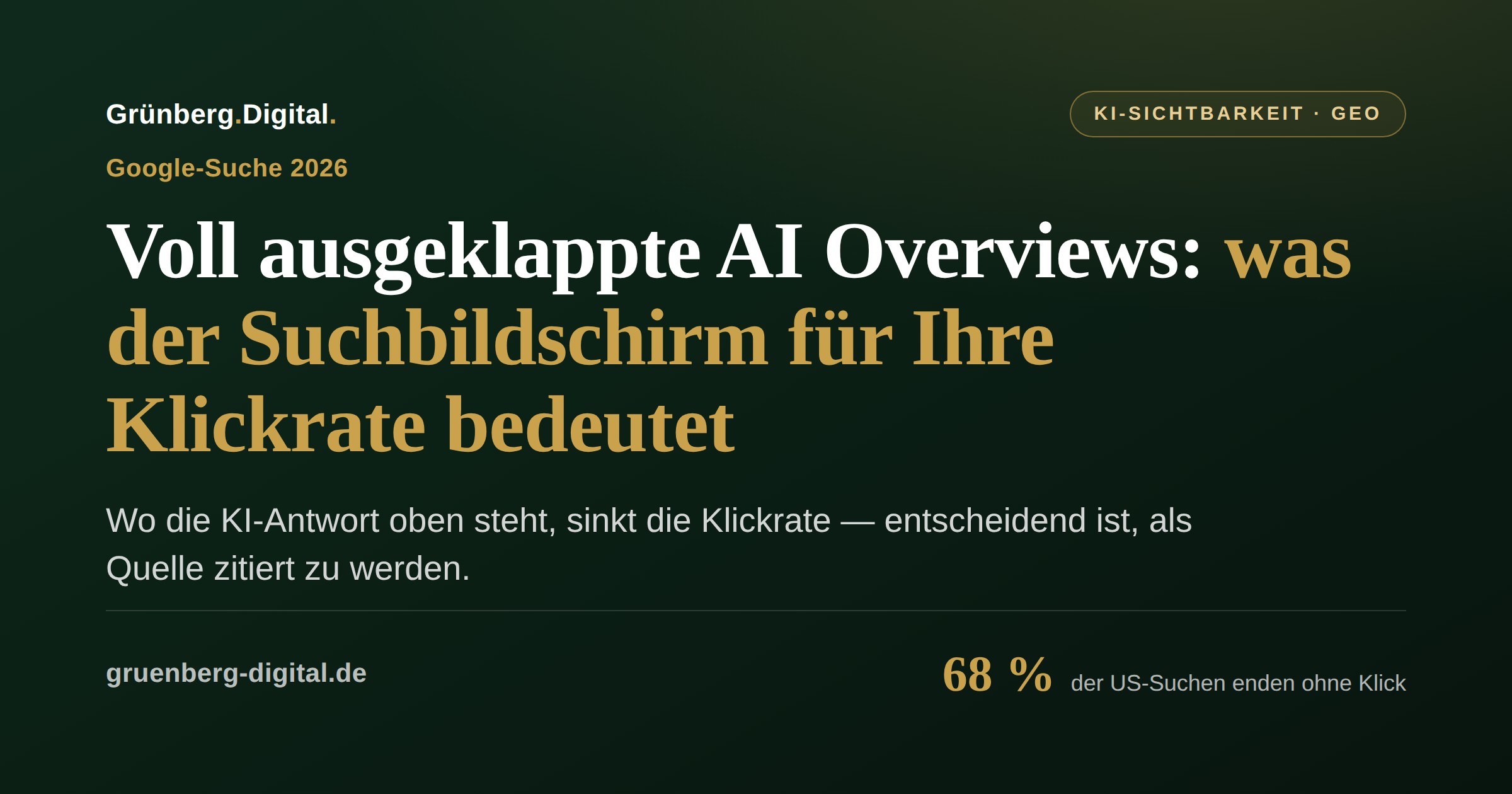
Anyone entering a question on Google in 2026 increasingly sees a detailed AI answer first at the top of the search screen. AI Overviews appear fully expanded more and more often, summarise several sources and take up a large part of the first screen. As a result, the classic organic results move further down – often below the visible fold.
For small and medium-sized enterprises, this shifts a basic assumption: a good position in the organic results no longer necessarily leads to a click if the answer is already above it. The decisive question is no longer just “Do I rank at the top?” but “Am I named in the answer?”. This article puts the observable development into context, shows the documented figures and describes how to become the cited source instead of disappearing from the answer.
1. What is changing on the search screen
First, an honest assessment: there is no dated announcement by Google according to which AI Overviews will automatically appear fully expanded from a certain day. What can be observed is a development over the course of 2026. The AI answers are getting longer, appear for more search queries and are placed more prominently at the top of the search screen. Overall, the balance of the first results page is shifting noticeably in favour of the generative answer.
In concrete terms: where the first organic links used to appear directly below the search box, in many cases there is now first a multi-paragraph summary with a handful of linked sources. According to an analysis by SparkToro, AI Overviews now appear on over 20 per cent of all Google searches. Where they appear, they shift attention away from the blue links and towards the answer itself.
The core of the shift: search increasingly answers the question itself instead of just pointing to answers. For websites, this means that the classic position one remains valuable but loses its exclusivity. In future, those named as a source in the AI answer will also be visible.
How deep this change goes is shown by a second figure from Google I/O 2026: according to the company, AI Mode, Google’s fully conversational answer mode, has over one billion monthly active users. Generative search is therefore not a niche format but a mass channel in which SMEs’ visibility is decided today.
2. What the figures show: click-through rate, zero-click and redistribution
The development can be quantified. According to a joint analysis by SparkToro and Similarweb, prepared by Search Engine Land, around 68.01 per cent of all US Google searches between January and April 2026 ended without a single click on a result. In 2024, this figure was still 60.45 per cent. Click-generating searches fell by 9.51 percentage points over the same period, which corresponds to a relative decline of 22.9 per cent.
We have already described this effect in principle in the article on zero-click search. What is new is the force with which AI Overviews amplify it: where an AI answer appears, the organic click-through rate falls by almost 60 per cent according to the same analysis.
For German-speaking countries, a compilation on stateinteractive.de provides additional figures. According to it, the organic click-through rate fell from 1.76 to 0.61 per cent according to Seer Interactive, a decline of around 61 per cent. BrightEdge measures in parallel that impressions rose by 49 per cent, but clicks fell by 30 per cent. So you are shown more often and yet clicked less often. Informational and fact-heavy queries are hit hardest, while brand searches remain resilient.
2.1 The decisive nuance: redistribution instead of disappearance
Anyone who reads only the declines can easily draw the wrong conclusion. The most meaningful analysis comes from the report “AIO Impact on Google CTR: 2026 Update” by Seer Interactive, which covers 53 brands, 5.47 million queries and 2.43 billion impressions between January 2025 and February 2026. It shows not a linear collapse but a redistribution.
The average click-through rate reached a low point of 1.3 per cent in December 2025 and rose again to 2.4 per cent by February 2026. What matters is where the clicks go: pages that are cited as a source in the AI Overview achieve a click-through rate of around 2.1 per cent. Pages not cited reach only around 0.9 per cent. Searches with no AI Overview at all remain at around 3.3 to 3.8 per cent.
Values rounded, based on Seer Interactive, as of February 2026. “Without AI Overview” stands for the corridor of around 3.3 to 3.8 per cent.
The clicks do not disappear; they are redistributed. Those cited as a source win a growing share of a shrinking number of clicks.
3. Which search queries are affected – and which are not
The shift does not affect all searches equally. Whether an AI Overview appears at all depends heavily on search intent. Seer Interactive analysed coverage by query type, and the differences are clear.
- Comparison searches (around 95 per cent): queries such as “provider A or provider B” almost always trigger an AI answer, because several sources can be summarised into a weighing-up.
- Questions (around 86 per cent): anything beginning with “how”, “what” or “why” is mostly dealt with directly in the answer.
- Information-driven queries (around 36 per cent): research searches without a clear question form receive an AI Overview less often, but regularly.
- Transactional queries (around 5 per cent): where someone wants to buy, book or commission, Google holds back. Here the classic results list remains dominant.
This pattern brings good news for many SMEs. Brand and navigational searches, in which users head for a specific company, remain stable. Anyone who knows your name and enters it still reliably ends up with you. By contrast, the informational queries at the beginning of the customer journey come under pressure – precisely the phase in which new prospects would first have to discover you.
Practical consequence: your transactional landing pages hardly lose any visibility. Your guide and knowledge content, on the other hand, needs a new task: it no longer just has to rank, it has to be citable so that your name appears in the answer.
4. What this actually means for SMEs
For a company with a lean team and no SEO department of its own, the figures lead to three sober conclusions.
First: purely informational traffic will predictably decline. If a guide article has so far brought visitors mainly via general knowledge questions, this channel is narrowing. That is no reason to abandon such content, but its purpose shifts from winning clicks to being worthy of citation.
Second: being named as a source becomes a value in its own right. Even without a click, your company name appears next to an answer that someone reads as a basis for a decision. This visibility effect is difficult to capture in an analytics account, but it has an effect on awareness and trust.
Third: withdrawal is not a viable answer. Since 2026, Google has offered a way to remove content from the generative features – we assessed it in the article on the AI Overviews opt-out in Search Console. For most SMEs, however, such an exit is the wrong signal, because it removes you from exactly the answer in which your future customers should find you. It makes more sense to meet the conditions under which you are cited.
5. Becoming the cited source: the steps to take
Being cited is not a matter of chance but the result of comprehensible properties. Generative systems prefer content that they can understand unambiguously, attribute cleanly and adopt without a jump in context. The following levers work together and can be implemented with manageable effort.
5.1 Structured data with Schema.org
Markup such as Article, FAQPage, Organization or Product makes your content machine-readable. It tells the system not only that a text exists, but what it means: who wrote it, which question a section answers, which offer it belongs to. This lowers the hurdle to capturing your page correctly as a source.
5.2 Clear entities instead of vague paraphrases
Name people, places, services and products unambiguously and consistently across your pages. If a model recognises beyond doubt which company, which region and which service is meant, it attributes your statements to the right entity – the basis of every citation.
5.3 Concise, answerable paragraphs
Use the question as the heading, give the direct answer in the first sentence and then explain it. This question-and-answer pattern is adopted more reliably than elegant but convoluted continuous text. Add figures with source and date as well as unambiguous definitions, because models prefer statements they can cross-check against other sources.
5.4 A clean FAQ section
An FAQ block, technically marked up with FAQPage, delivers exactly the format that generative systems like to cite: a clearly stated question and a short, self-contained answer. It serves both your readers and your visibility in the answer.
5.5 Verifiable authority and up-to-dateness
Author details with qualifications, evidence, consistency across channels and a visible update date strengthen your credibility. Why these signals help determine how often you are cited is explained in the article on E-E-A-T and AI authority. Our overview of Generative Engine Optimization gives the overall picture of this discipline.
The connecting idea: you no longer optimise just for a position in the list, but for delivering the best citable answer to a specific question. This helps in both worlds – in classic search and in the generative answer.
6. Measuring instead of guessing: the Search Console report
Without data, any discussion about AI Overviews remains a matter of opinion. That is why in 2026 Google added a report for generative search to Search Console, which allows impressions and clicks from AI formats to be viewed separately. This lets you see for which queries your page appears as a source and how this visibility develops over time.
How to set up the report and read it correctly is shown in our detailed guide to the Generative AI report in Search Console. To get started, a lean rhythm is enough:
- Record the starting point: note impressions and clicks from AI formats as a baseline before you revise content.
- Filter by intent: check separately how informational and transactional queries develop – the shift affects them differently.
- Track citability: observe whether revised pages appear more often as a source, and prioritise the next ones accordingly.
7. Conclusion: visibility is shifting, not disappearing
The search screen of 2026 looks different from that of 2023. AI Overviews appear in more detail and more often, the organic results move down, and a growing share of searches end without a click. For SMEs that have so far relied heavily on informational traffic, this is a real change in the rules of the game.
The figures, however, do not tell the story of a disappearance, but of a redistribution. Clicks flow to where a page is cited as a source. Those who take on this role win a growing share of increasingly scarce attention. Those who ignore it or withdraw voluntarily lose contact before it is made.
The worthwhile investment therefore lies not in fending off the AI answer, but in being cited: clear structure, clean markup, evidenced statements, verifiable authority and honest measurement via Search Console. This work has an effect in classic search and in the generative answer at the same time – and it is quite manageable for an SME without a large team.
Sources: Search Engine Land and SparkToro (zero-click and click-through rate analysis 2026), Seer Interactive (“AIO Impact on Google CTR: 2026 Update” and intent coverage), BrightEdge (impressions and clicks in the German market), compilation on stateinteractive.de and Google I/O 2026 on AI Mode.
8. FAQ: the most important questions about expanded AI Overviews
Are AI Overviews automatically shown fully expanded in 2026?
There is no dated Google announcement that AI Overviews will automatically appear fully expanded from a particular day. What can be observed in 2026, however, is a clear development: AI Overviews appear in increasingly detailed form and take up the upper search screen, so that the classic organic results move down. According to SparkToro analyses, they appear on over 20 per cent of searches.
How much does the click-through rate fall because of AI Overviews?
Where an AI Overview appears, the organic click-through rate falls by almost 60 per cent, according to Search Engine Land and a SparkToro analysis. In the German market, the organic click-through rate fell from 1.76 to 0.61 per cent according to a Seer Interactive analysis, a decline of around 61 per cent. Informational and fact-heavy queries are affected most, while brand searches remain more resilient.
Does click traffic disappear completely or is it merely redistributed?
It is redistributed. According to Seer Interactive, the click-through rate hit its low point of 1.3 per cent in December 2025 and rose again to 2.4 per cent by February 2026. Pages cited in AI Overviews achieve a click-through rate of around 2.1 per cent, pages not cited only around 0.9 per cent. Searches with no AI Overview at all are at around 3.3 to 3.8 per cent. The core message: not disappearance, but redistribution in favour of the cited sources.
Which search queries are particularly affected and which are not?
According to Seer Interactive data, AI Overviews appear for around 95 per cent of comparison searches and around 86 per cent of questions, for around 36 per cent of information-driven queries and for only around 5 per cent of transactional queries. Brand and navigational searches remain stable because users are heading for a specific destination.
What can SMEs actually do to stay visible?
Instead of fighting the development, SMEs should make sure they are cited as a source in the AI Overview. This includes structured data with Schema.org, clearly named entities, concise answerable paragraphs in a question-and-answer pattern, an FAQ section, verifiable authority in the sense of E-E-A-T, and up-to-date content with date and source.
How do I measure my visibility in AI answers?
In 2026, Google added a report for generative search to Search Console. It allows impressions and clicks from AI formats to be analysed separately. This lets you see for which queries your page appears as a cited source and whether this visibility is growing over time, instead of just speculating about it.