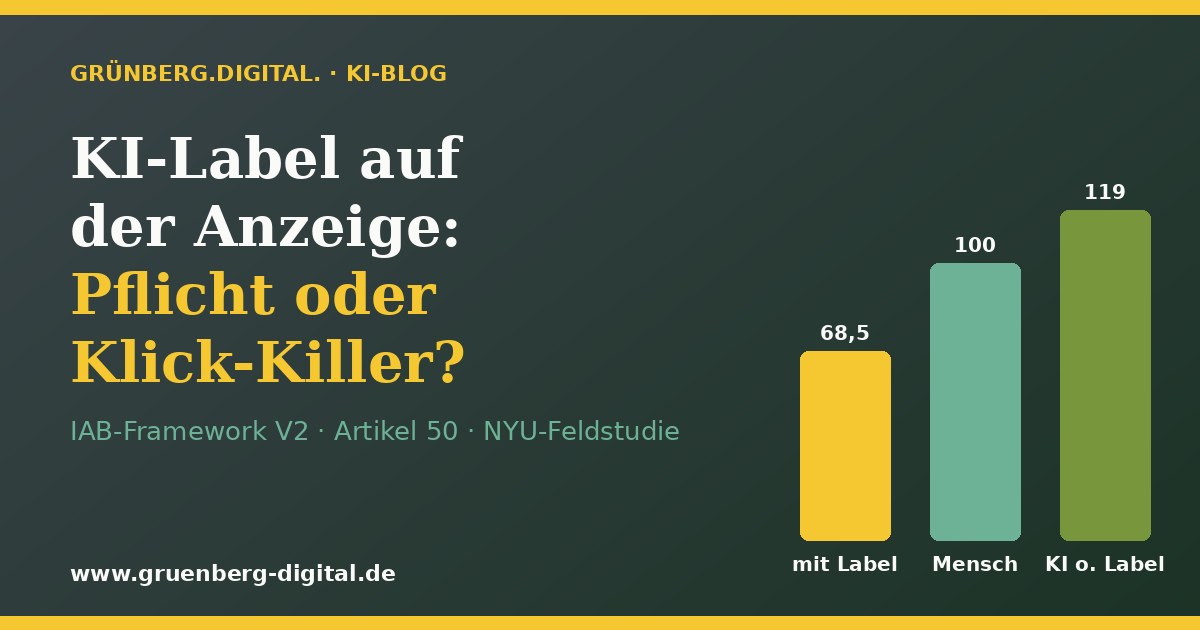
Two news items from August 2026 belong together but are rarely read together. On 2 August, Article 50 of the EU AI Act became binding – the transparency obligation for AI-generated content. On 18 August, the Interactive Advertising Bureau (IAB), the industry association of the digital advertising business, published the second version of its AI Transparency & Disclosure Framework. And between the two stands a figure that the IAB itself cites: in a field experiment by NYU Stern, the click-through rate of ads fell by 31.5 per cent as soon as they were labelled as AI-generated.
For companies that create ads with AI – and in 2026 that is most of them – this raises an uncomfortable question: what has to be labelled, what may run without a label, and what does labelling cost? This article answers all three questions on the basis of the primary sources.
1. One label, two figures: what it is about
The IAB presented its first framework in January 2026, together with a consumer study by the Sonata Insights institute. Its findings were mixed: some respondents viewed AI positively in creative contexts, others found it inauthentic. Nevertheless, more than half wanted brands to disclose when an ad is fully AI-generated or contains AI images and videos. And 73 per cent of Gen Z and millennials said that clear labelling would increase or not affect their likelihood of buying.
This is contrasted with the second figure: the 31.5 per cent from the NYU field experiment. So consumers say they want transparency – and then click less often when they get it. Framework V2 tries to resolve precisely this tension by not requiring everything to be labelled, but only what could actually mislead consumers.
In short: the IAB argues that a label on every ad teaches consumers to ignore labels – and harms advertisers without protecting anyone. Labels should appear where AI changes authenticity, identity or representation.
2. What IAB Framework V2 requires – and what it does not
The framework sorts AI use into two groups. The first group justifies a label, because realistic synthetic content could change what consumers believe they are seeing:
- Images and videos generated from prompts – i.e. photorealistic scenes, people and products that never existed in that form.
- Certain synthetic voices and avatars that could be perceived as real people.
- Digital doubles of deceased persons and digital doubles of living persons in invented situations that go beyond an ordinary brand testimonial.
- Chatbots and AI assistants that a consumer could mistake for a human contact.
The second group does not trigger automatic labelling. The IAB explicitly includes: routine post-production, internal workflows, recognisably fantastical imagery, authorised synthetic voices of real people, generic synthetic voices, background music, standard audio editing, digital doubles in an ordinary testimonial, obviously drawn or stylised avatars – and text and copy.
The last point is the most important for mid-sized companies: ad copy written with AI, the product description, the subject line – none of this needs a label under the framework. What matters is not whether AI was involved, but what it did. For US practice, the framework offers two formats: a standardised sparkle icon (“Sparkle Icon”) or a clear text statement. Both count as full disclosure, and there are also requirements for the accessibility of the label.
Important: the framework is an industry recommendation and does not replace any law. The IAB itself writes that state and international regulation takes precedence. For German companies, the EU AI Act is decisive – the framework helps as a decision grid, not as a legal basis.
3. The study behind the figure: 31.5 per cent fewer clicks
The figure comes from the paper “The Impact of Visual Generative AI on Advertising Effectiveness” by Hyesoo Lee and Anindya Ghose (NYU Stern) and Vilma Todri and Panagiotis Adamopoulos (Emory University), published at the end of 2025. The researchers did not ask questions in the laboratory, but served real ads on the Google Display Network and measured clicks. Three results are relevant for advertisers:
Indexed representation of the reported effects: +19 % for unlabelled AI ads, −31.5 % with labelling, in each case compared with unlabelled human ads. As of: September 2026.
The third finding is remarkable. The researchers distinguish between “GenAI created” – the AI designs the ad completely from scratch, including composition, colour, perspective – and “GenAI modified” – the AI only swaps the background or face of an existing template via inpainting. The modified ads were perceived as less realistic, which lowered purchase intent. The freely generated ads, by contrast, had a stronger emotional effect and were quicker to take in. According to the study, if you use AI only as a retouching tool, you get the worst of both worlds.
And one more limitation belongs here: the 31.5 per cent applies to display banners in a field experiment. The study did not measure whether the effect is equally large in search ads, on social platforms or for video ads. It is a strong signal, not a law of nature.
4. What this actually means for SME ads
If you lay the framework over the typical ad portfolio of a mid-sized company, the labelling question becomes manageable. Most AI work is text: Google Ads ads, Meta primary texts, product descriptions, email subject lines. None of this needs a label according to the IAB. The AI-generated colour gradient, the cut-out product shot or the stylised illustration look are also unproblematic.
The question arises with three types of asset that SMEs increasingly use:
4.1 Photorealistic people and scenes
The AI-generated team photo, the guest at the hotel breakfast table, the tradesman in front of the company van – if these people never existed and the scene is meant to look real, this is exactly the case for which the framework provides a label. And which the EU rule covers anyway.
4.2 Synthetic voices in video ads
A generic AI voice reading an advertising text is considered unproblematic by the IAB. The case is different if the voice imitates a recognisable person or an avatar appears as “our adviser”. If you produce AI video advertising with Sora or Veo, you should know this line.
4.3 Chatbots at first contact
The AI assistant on the landing page or in the WhatsApp channel must make itself recognisable as AI as soon as a customer could take it for a human. The IAB requires this – and Article 50 of the AI Act also requires it, bindingly. What this looks like in practice at first contact is described in our article on the AI labelling obligation under Article 50.
5. EU and USA: Article 50, icon and code of practice
The IAB describes the situation in the USA as comparatively clear: sparkle icon or text label, both satisfy the industry recommendation. In parallel, individual states have issued their own rules – New York’s law on synthetic performers has applied since June 2026, California’s SB 942 with metadata and labelling obligations since 2 August 2026. South Korea also introduced labelling obligations with its revised AI Basic Act at the beginning of the year.
In the EU, the situation is “in flux”, according to the IAB. Article 50 of the AI Act has been binding since 2 August 2026 and requires AI-generated content and deepfakes to be disclosed – but does not prescribe a particular symbol. The accompanying code of practice, which the EU Commission finalised in June 2026, is voluntary. It contains design and placement requirements for AI labels as well as examples of a possible common EU icon – which, however, has not yet been finally determined.
In practice, this means: a German company can currently follow the code of practice for how to label, but must expect the symbol to change. On whether to label, there is less leeway than in the IAB framework: Article 50 covers AI-generated images, audio and video in principle, not only the “misleading” cases. Details on exceptions and provider and deployer obligations can be found in the Article 50 article.
6. Transparency versus click-through rate – a conflict that can be resolved
The obvious reading of the 31.5 per cent is: labelling does harm, so label as little as possible. This reading falls short – for three reasons.
First, the study measures clicks, not trust. An ad that gets more clicks without a label and later sticks in the customer’s mind as “deceptive” has paid dearly for the click. The IAB’s Sonata survey shows that younger target groups in particular expect disclosure. Second, advertisers’ biggest lever is not the label at all but the choice of asset: if you use real photos for people and scenes and use AI for text, layout, variants and abstract elements, you will not need a single label in most campaigns – and still be on the safe side. Third, platforms are increasingly taking the decision off your hands: according to industry reports, Meta now automatically detects and labels third-party AI media in ads. Where the label appears anyway, the question is no longer “whether”, but only whether the campaign is prepared for it.
Our recommendation: do not avoid the label, avoid the case that needs a label – where possible. And where a photorealistic AI scene really is the best ad, measure the effect of the label instead of fearing it: test the same ad with and without labelling before scaling the budget.
7. Checklist: checking ad assets in six steps
Would you like to have your ad assets and campaigns systematically checked for AI use and labelling requirements? Arrange a free initial consultation with our team.
8. Conclusion: label what has a face or a voice
IAB Framework V2 brings order to a debate that has so far swung between “label everything” and “label nothing”. Its line is workable: a label belongs where AI creates something that looks real but is not – people, voices, situations. Text, layout and retouching remain free. In the EU, Article 50 draws the line somewhat more tightly, but the idea is the same.
The 31.5 per cent from the NYU study is less an argument against transparency than an argument for smart asset decisions. If you use AI where it brings the most and deceives the least, you will rarely need the label – and where it is necessary, you can carry it with a clear conscience and a measured effect.
Our assessment: in 2027, the labelling question will not be a competitive disadvantage for those who settled it early – but for those who are surprised in the first quarter by automatic platform labelling or a supervisory authority. One hour of asset inventory today saves the crisis meeting tomorrow.
Read also: AI labelling obligation 2026: what Article 50 of the AI Act means for your marketing and AI video advertising 2026: commercials in minutes instead of weeks.
9. FAQ: frequently asked questions about AI disclosure in ads
Do I have to label AI-generated ad copy?
Not under IAB Framework V2: text and copy are explicitly on the list of uses that do not trigger an automatic label – as are routine post-production, background music, generic synthetic voices and recognisably stylised avatars. For texts, the EU AI Act (Article 50) only requires labelling if they are published to inform the public on matters of public interest and no human review took place. This generally does not apply to ordinary advertising copy.
Which AI ads need a label according to the IAB?
A label is intended where AI changes authenticity, identity or representation in such a way that consumers believe they are seeing something other than what is actually the case: photorealistic images and videos generated from prompts, certain synthetic voices and avatars, digital doubles of deceased persons, digital doubles of living persons in invented situations, and chatbots that could be mistaken for human contacts.
What exactly did the NYU study on AI labels measure?
In a field experiment on the Google Display Network, researchers from NYU Stern and Emory University measured that fully AI-generated ads achieved up to 19 per cent more clicks than human-designed ones – as long as they were not labelled as AI. As soon as the ads were openly marked as “AI-generated” or “AI-edited”, the click-through rate fell by around 31.5 per cent compared with unlabelled human ads. The IAB cites this study as an argument against blanket labelling of all AI use.
Does the IAB framework also apply in Germany?
The IAB framework is an industry recommendation from the USA and not a law. In the EU, the AI Act is decisive: Article 50 has applied since 2 August 2026 and requires AI-generated content and deepfakes to be labelled, without prescribing a particular symbol. The accompanying code of practice from the EU Commission is voluntary; a uniform EU icon has not yet been finalised. For German companies, the framework is helpful above all as a decision grid for which assets need to be checked at all.